


Article Content
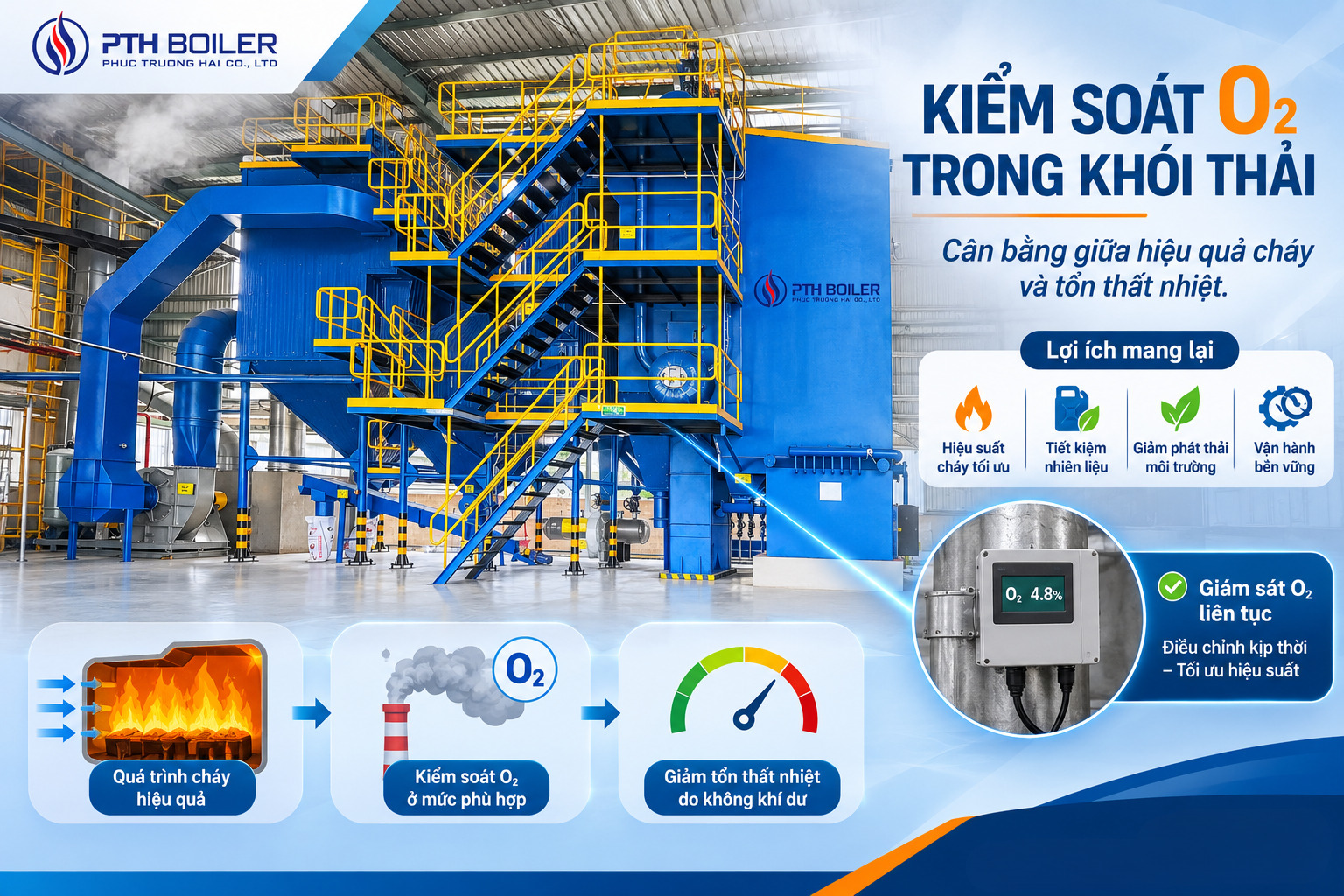
In industrial boiler operation, optimizing efficiency depends not only on fuel quality and boiler design capacity but also on effective combustion control. One of the key parameters that must be continuously monitored is the O₂ (oxygen) concentration in the flue gas.
An excessively low O₂ level may result in incomplete combustion, while an excessively high O₂ level indicates excessive air supply, increasing heat losses through the flue gas. Therefore, maintaining an appropriate O₂ level is essential to balancing combustion efficiency, fuel consumption, and overall boiler operating performance.
1. Why Is Flue Gas O₂ Control Important?
During the combustion process, air is supplied to the furnace to provide oxygen for fuel oxidation. In practice, the actual air supply is generally greater than the theoretical air requirement to ensure effective fuel combustion.
The residual oxygen remaining after combustion is reflected in the O₂ concentration of the flue gas. This is an important indicator for evaluating excess air levels and the overall condition of the combustion system.
However, supplying more air does not necessarily result in better combustion. Excessive air increases the mass flow rate of gas that must be heated, causing more heat energy to be carried away through the flue gas and discharged via the stack.
Conversely, insufficient combustion air may lead to incomplete combustion, increasing CO emissions, unburned fuel, and the risk of operational issues.
2. High and Low O₂ Levels: Two Types of Losses to Control
When the O₂ concentration in flue gas is too high:
-
Excessive combustion air increases the flue gas flow rate.
-
More heat is carried away with the flue gas, resulting in higher stack heat losses.
-
Electricity consumption by forced-draft and induced-draft fans may increase.
-
Boiler thermal efficiency may decrease, leading to higher fuel consumption and operating costs.
When the O₂ concentration in flue gas is too low:
-
Localized oxygen deficiency may occur within the furnace.
-
The formation of CO due to incomplete combustion may increase.
-
Unburned carbon content in ash and bottom ash may rise.
-
Flame stability, furnace temperature, and overall boiler operating performance may be adversely affected.
Therefore, the objective is not to reduce O₂ to the lowest possible level, but to maintain sufficient oxygen for effective combustion while minimizing unnecessary excess air.
3. O₂ Control Solutions for Optimizing Boiler Efficiency
Effective control of flue gas O₂ concentration requires a combination of measurement instruments, control systems, and operational adjustments.
Monitoring O₂ Using Flue Gas Analyzers
Installing O₂ sensors or flue gas analyzers at appropriate locations along the flue gas duct allows continuous monitoring of residual oxygen levels. The measured data provides a basis for evaluating combustion conditions and adjusting the combustion air supply accordingly.
Optimizing the Fuel-to-Air Ratio
The control system must coordinate fuel feed rates and combustion air flow to maintain an appropriate fuel-to-air ratio under varying boiler load conditions. In advanced control systems, O₂ measurement signals can be used for trim control to fine-tune combustion air supply based on actual operating conditions.
Optimizing Air Distribution Within the Furnace
For boilers firing biomass or other fuels with variable characteristics, the distribution of primary and secondary air, together with fuel feed adjustments, plays a particularly important role. The objective is to ensure uniform oxygen distribution, minimize localized oxygen-deficient zones, and avoid excessive air in certain areas of the furnace.
Controlling Flue Gas Temperature and Recovering Waste Heat
In addition to O₂ concentration, flue gas temperature, furnace pressure, and CO levels should also be monitored to provide a comprehensive assessment of combustion performance. Furthermore, the use of economizers, air preheaters, and other suitable heat recovery solutions helps recover residual heat from flue gas before it is discharged into the atmosphere.
4. There Is No Universal Optimum O₂ Level for All Boilers
A common mistake is to apply the same target O₂ concentration to every boiler system.
In reality, the appropriate O₂ level depends on several factors, including:
-
Fuel type and combustion characteristics.
-
Boiler capacity and furnace configuration.
-
Combustion technology and air supply arrangement.
-
Boiler load and operating conditions.
-
Equipment condition, system air leakage, and measurement location.
In particular, for biomass fuels with varying moisture content, particle size, and composition, O₂ control must be adjusted flexibly according to actual operating conditions rather than relying on a single fixed setpoint.
5. O₂ Control – A Key Solution for Sustainable Boiler Performance
Flue gas O₂ control is more than simply adjusting an operating parameter; it is an essential part of a plant's energy optimization strategy.
When properly implemented, this approach helps minimize incomplete combustion, reduce excess-air-related heat losses, improve boiler thermal efficiency, and lower operating costs.
With extensive experience in the design, fabrication, installation, and retrofit of industrial boiler systems, Phuc Truong Hai (PTH) is committed to delivering optimized operating solutions tailored to the fuel characteristics and steam requirements of each industrial facility.
PTH focuses not only on equipment performance but also on improving energy utilization, minimizing waste, and promoting greater sustainability in industrial production.
Related Articles

12 Aug, 2024
Energy transition – The fight against climate change

12 Oct, 2026
FLASH STEAM RECOVERY – TURNING WASTED ENERGY INTO VALUE

30 Oct, 2026


